Wednesday, October 31, 2007

Code changes in Gmail

After inclusion of IMAP in Gmail not even a week back, I was not expecting something new so soon from Gmail. But as it turns out, the gmail team has surprised me once again by changing the interface a little bit. It first came to my notice last night when I checked my email and noticed a bit of change in the interface in the chat window. It looked a lot nicer. The same was true for all my contacts too.
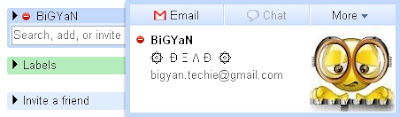
But I was dissapointed to find out that the menu options did not include anything new. I have no idea what they could have possibly added to it, but maybe a link to the individual's Blogger blogs or GooglePages website or Picasa public albums? I guess we will have to wait for that.

The first reaction after this was definitely to check the top right corner of the page where I was looking for the cool "New Features" link. Instead I saw this :

Hmmm, option to switch over to old version !! Who would possibly want to do that? .... browser compatibility issues maybe? Well as it turns out, I was right, the new version is currently supported by IE 7 and Firefox 2. The official Gmail blog says that this code change uses "a new model that enables us to iterate faster and share components".

The list of modifications are :
  • Contact Manager has been upgraded.Even if you do not have the new Gmail version, you can still access this cool new thing at http://mail.google.com/mail/contacts/ui/ContactManager?js=RAW
  • The mouse over menu for the contacts have been revamped.
  • Few new keyboard shortcuts have been added.
  • Bookmark specific emails.
  • Bookmark specific searches. Like for searching for "orkut", the bookmark address would be "http://mail.google.com/mail/?ui=2#search/orkut". Do try this out.
  • Loading time has decreased. The new UI is faster; although I do not know whether this is for Firefox 2 or all browsers. In any case this would not matter much except for power users.
So if you are still not using Firefox 2 or IE 7, here is one more reason to upgrade. Firefox 2 is free and IE 7 has officially become free from the last couple of weeks, so there can be nothing stopping you from upgrading to these latest browsers and experiencing these cool features.

You can have a look at the official release notes, "Code changes to prepare Gmail for the future" for more information. In case you found out something more, do drop a post here.

Monday, October 29, 2007

Seagate sued over Gigabyte Definition

"Seagate Technology, the world's largest hard-drive maker, is offering customers a five percent refund on drives bought during the last six years following a lawsuit over the definition of a "gigabyte". As an alternative, customers can choose to receive free backup software." Reportedly, a group of four people sued the company over the fact that they were cheating customers by mentioning larger number of Gigabytes for their HDDs than what was actually provided. The problem arises from the definition of gigabyte. One gigabyte is actually defined as 2^30 bytes or 1024^3 bytes. But HDD manufacturers have been measuring gigabyte as 1000^3 bytes. The difference turns out to be about 73,741,824 bytes per GB. For 20GB drives this results in 1.5GB loss of space. All other HDD manufacturers like Samsung, Hitachi and Western Digital all measure GB as 1000^3 number of bytes. I have been asking a lot about it for a long time for now, but all of my queries have met with the common answer, "That's how it is measured by HDD manufacturers". It's good to see that somebody has finally sued the company on this issue. The only question is how to claim the refund or the software? I visited the Seagate webpage recently and did not find anything there. I searched for "refund" and nothing worthwhile came up. But I will surely keep an eye on it. I have a total of 6 HDDs that were bought on or after 2001, so I guess I will gain a bit from this. If you know where to claim the refund or the software from Seagate, do let me know. Here are the links to the original article by Peter Judge and the Seagate Website.

VS 2008 Beta 2 VPC Image Expires on 1st Nov

Today to my utter dismay, I learnt that the VPC images of Visual Studio Beta 2 will actually be expiring on November 1st, 2007 instead of what was originally announced to be March 15th, 2008. Reportedly, the problem is at the OS level, so changing back the system date is not a solution as this would not re-enable the OS image. So all you fellows who were busy getting their hands wet with the VPC images of Visual Studio Beta 2, create backups of all your projects. On November 1st, the software is supposed to stop functioning; I hope MS will come up with a patch to re-enable it till the originally announced date of March 15th, 2008. However no such announcements have come to my notice. Check out Paul Litwin's Blog to find out more on this. I will be keeping an eye on the official VS 2008 information page for probable patches. Jeff Beehler's blog gives a much more detailed report of this problem and possible workarounds. Edited on Ost 31, 2007 Finally MS has released the new set of VPC images. You can download them from the VS 2008 Download page.

Sunday, October 28, 2007

User Group meeting on 27th Oct '07

The 27-10-2007 meeting was on "How to get SUCCESS in an Interview... in .NET and SQL Server, Frond End / UI and Database Developer". Abu, the main speaker, started with the homework that one should do before appearing for the interview. We discussed the total time needed for it and what are the key points essential for a good preparation. The discussion also included some of the methods that one should follow for achieving this target. We discussed what were the general types of questions asked and what should be their answering format. What should be the answer to the standard "rate yourself" and "tell me about yourself" type of questions and how to approach them. Approach to HR questions were also discussed. Abu showed us a sample CV and discussed what all should be there in a CV; what to give for freshers, what for 2 yrs experience. The dress code on the day of the interview and the best behavioral practices were also discussed. Abu stressed on the fact that an interview the candidate can also ask questions and what questions a candidate must ask. The last topic to be covered was telephonic interview. How to approach them were discussed regarding where to receive the call, what to have with you at the time of the interview. Abu stressed on the fact that having a copy of CV in front is one of the essential things which is often overlooked. The meeting was overall an interactive session where I could gather much about how to prepare for an interview and how to give the interview so as to maximize my chances. From what I could gather, the most essential things for achieving this goal is to prepare thoroughly and to have a cool head to tactfully answer all the questions.

Friday, October 26, 2007

Elimination of Dihydrogen Monoxide

A friend of mine send me this interesting article about a sociological experiment. I do not know whether it is true or not, but nonetheless it makes for an interesting read and give some insight into the human gullibility even in this scientific age. A junior high school student from USA won the first prize at the Greater Idaho Falls Science Fair. He was attempting to show how conditioned we have become to false reports when they come with a scientific packaging; how pseudo science is spreading fear of everything in our environment. To demonstrate this, he came up with the novel idea of urging people to sign a petition in demand of elimination or strict control of the very harmful chemical "dihydrogen monoxide". To back up the claim he had plenty of reasons as to why it should be banned :
  • major component in acid rain and is also known as hydroxyl acid
  • can cause excessive sweating and vomiting
  • accidental inhalation can kill you
  • contributes to erosion of our landscape
  • can cause severe burns in its gaseous state
  • decreases effectiveness of automobile brakes
  • causes electrical failures
  • has been found in tumors of terminal cancer patients
The fellow also quoted the degree to which this harmful chemical Dihydrogen Monoxide has contaminated our lives :
  • found in large amounts in every stream, lake and reservoir
  • used as fire retardant
  • used in most forms of animal research
  • used as industrial solvent and coolant
  • used in food products and beverages of all types
The result of the campaign was very interesting. Out of a sample of 50 people, 43 were in favour of banning the chemical, 6 were undecided and only 1 could actually see through the fact that Dihydrogen Monoxide was actually pure water. The conclusion is obvious. We should not be intimidated by scientific pompous names. I have often observed that people are more likely to believe things which have big scientific names attached to them than which does not. We should just have some sense and learn to listen carefully before we pass on a judgment only because the something sounds scientific. At all the levels, science teaches us to think logically and not merely to believe.